Casino
 Betting
 Games
Games 
 Banking
 Bonuses

New Zealand vs Indonesia: Two Countries, Two Gambling Models, One Region

- New Zealand vs Indonesia: Two Countries, Two Gambling Models, One Region

 Author: Lukas Mollberg
 Updated: 30 June, 2026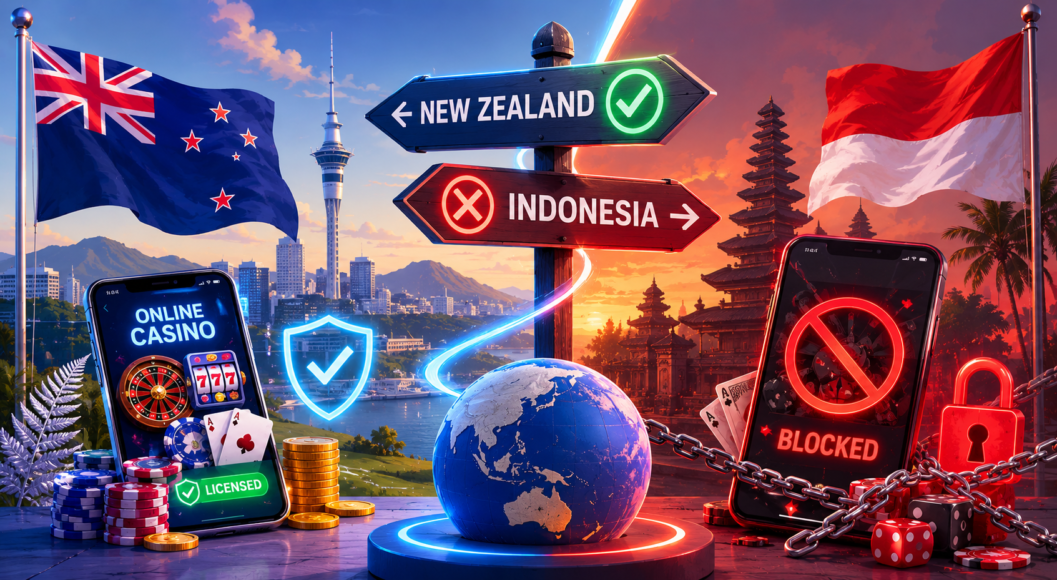
Two countries. One region. Completely opposite approaches to online gambling.
In May 2026, New Zealand became one of the first countries in the Asia-Pacific to launch a fully licensed, regulated online casino market under the Online Casino Gambling Act 2025.
Across the Tasman and further north, Indonesia maintains one of the strictest total gambling bans in the world — enforced by criminal law, rooted in Islamic values, and backed by aggressive digital blocking. Both approaches claim to protect citizens. Both have serious consequences for players and operators alike. But only one of them is working.
We at Casinoble have gone deep on both models — the laws, the enforcement realities, the black market consequences, and what the contrast tells us about how governments in this part of the world are choosing to deal with one of the internet's fastest-growing industries.
New Zealand's Model: Regulate, License, and Tax
New Zealand's Online Casino Gambling Act 2025 came into force on 1 May 2026. It is the country's first dedicated legal framework for online casino gambling and represents a fundamental shift in how the country approaches digital gaming.
Before the Act, New Zealand had no licensing system for online casinos. Offshore operators could — and did — accept New Zealand players with virtually no local oversight. Players had limited recourse when things went wrong. Tax revenue from online gambling flowed entirely overseas. And problem gambling tools on offshore platforms were inconsistent at best, non-existent at worst.
The Act changes all of that. It establishes a competitive licensing regime administered by the Secretary for Internal Affairs. Operators must go through a rigorous three-stage process: an expression of interest, a competitive tender or auction, and a full licence application that includes detailed strategies for harm minimisation, consumer protection, advertising, and regulatory compliance. Up to 15 licences can be issued at any time, with no single entity permitted to hold significant influence over more than three licences.
What the Law Covers
The NZ online casino law covers any gambling conducted at a distance through a communication device — phones, tablets, and computers. This includes online pokies and slot machines using random number generators, casino table games like blackjack, baccarat, roulette, and poker, and computer-simulated virtual sports. Licensed operators must also support local payment methods — players using POLi online casino payments are fully covered under the regulated framework. Sports betting, horse racing, and the Lotteries Commission's products — Lotto, Powerball, and Strike — are separately governed and explicitly protected from competition by licensed online casinos.
Player Protections Built Into the Law
Consumer protection is central to the NZ gambling regulation 2026 framework. Licensed platforms — including those accepting players with as little as a 1 NZD minimum deposit — must verify that players are at least 18 years old. They must identify and exclude problem gamblers. They must maintain a complaints register and respond to all complaints within 40 working days. A national self-exclusion register must be operational by 1 December 2027, allowing players to opt out of all licensed platforms simultaneously.
Advertising is tightly controlled. Regulations targeting harm minimisation and under-18 marketing must be in place by 1 December 2026. Every licensed site must display a verified registration icon — a trust badge issued by the Secretary — on its platform and in all advertisements. Sites without it are operating illegally and face take-down notices, payment blocking, and financial penalties of up to NZ$5 million per breach.
Where the Money Goes
Online gambling duty has been raised from 12% to 16% under the Act. Twenty-five percent of all online gambling duty collected is ring-fenced and flows directly into the same community fund that already distributes Lotto profits — supporting sports clubs, arts organisations, and community groups across New Zealand. Even lower-barrier entry points like 10 NZD deposit casinos contribute to this levy pool under the new framework. Operators also pay a problem gambling levy. For the first time, New Zealand online casino revenue stays in New Zealand.
Indonesia's Model: Total Prohibition, Maximum Enforcement
Indonesia sits at the opposite extreme. All forms of gambling — land-based or online, games of chance or skill, small-stakes or large — are completely illegal under Indonesian law. The prohibition is rooted in both the state criminal code and Islamic law, which governs the moral and legal framework of the world's largest Muslim-majority nation.
The Criminal Code of Indonesia prescribes imprisonment and fines for gambling. Online gambling carries additional penalties under the Electronic Information and Transactions (ITE) Law, which gives authorities broad powers to block digital content deemed illegal. The government's communication ministry — Kominfo — operates one of the most active internet blocking regimes in the Asia-Pacific, with tens of thousands of gambling-related URLs blocked annually.
The Enforcement Reality
The scale of Indonesia's blocking activity is significant. In 2023 and 2024, Kominfo reported blocking hundreds of thousands of online gambling links and domains. In 2024 alone, Indonesian authorities reported blocking over 1.9 million gambling-related URLs — a figure that reflects both the government's commitment to enforcement and the sheer scale of the platforms trying to reach Indonesian users.
Despite this, the illegal online gambling market in Indonesia remains enormous. According to online casino data for Indonesia, estimates from various research bodies place the value of illegal online gambling in Indonesia at between IDR 300 trillion and IDR 600 trillion per year — equivalent to roughly US$18 billion to US$36 billion annually. That makes Indonesia's black market one of the largest illegal gambling markets in Southeast Asia, and possibly the world relative to its regulatory stance.
The reasons are structural. Indonesia has over 200 million internet users. Smartphone penetration is high and growing. VPN usage is widespread — driven initially by access to social media during previous blocking episodes, and now routinely used to access blocked gambling platforms. The demand for online gambling in Indonesia has not been eliminated by prohibition. It has simply been redirected to unregulated, untaxed, and often criminal offshore platforms.
Who Is Harmed
The consequences of Indonesia's prohibition-without-channelisation model fall hardest on ordinary players. Indonesians who gamble online do so on platforms with no consumer protections, no age verification requirements, no self-exclusion tools, and no grievance mechanisms. When a platform disappears with player funds — a common occurrence in the black market — there is no recourse. There is no regulator to complain to. There is no legal framework protecting the player's money.
Problem gambling in Indonesia is also a serious and underreported issue. Because gambling is illegal and socially stigmatised, Indonesians who develop gambling addiction face significant barriers to seeking help. There is no licensed operator required to identify and support problem gamblers. There is no self-exclusion register. There is no problem gambling levy funding treatment services. The harm happens in the dark.
Side by Side: How the Two Models Compare
The contrast between New Zealand and Indonesia is stark — and instructive. New Zealand has chosen the harder regulatory path: build a licensed market, impose strict standards, collect tax, fund communities, and protect players within a legal framework. Indonesia has chosen the simpler legal path — total prohibition — but is living with the complex and harmful consequences of a black market it cannot eliminate.
The evidence from comparable regulatory debates globally is consistent. Prohibition without effective enforcement does not eliminate gambling demand. It pushes demand underground, to platforms that are unaccountable, untaxed, and unsafe. New Zealand's approach accepts that demand exists, channels it into a regulated framework, and uses the resulting revenue and oversight mechanisms to minimise harm.
Neither model is perfect. New Zealand's licensed market is brand new, and its long-term effectiveness remains to be proven. The 15-licence cap is deliberately restrictive, and some consumer advocates argue that the market could become too concentrated. Indonesia's enforcement commitment is genuine — the sheer scale of URL blocking demonstrates political will — but the black market evidence suggests it is fighting a losing battle against demand, technology, and human behaviour.
NZ vs Indonesia Gambling: Full Comparison Table
| Dimension | New Zealand 🇳🇿 | Indonesia 🇮🇩 |
| Legal framework | Online Casino Gambling Act 2025 | Criminal Code + ITE Law |
| Online casino status | Legal — licensed and regulated | Completely illegal |
| Regulatory body | Secretary for Internal Affairs | Kominfo (blocking) + Police |
| Licensing system | Yes — competitive, 3-stage process | None — total prohibition |
| Maximum licences | 15 nationwide | 0 |
| Licence duration | 3 years initial; 5 years on renewal | N/A |
| Governing religion/values | Secular — harm minimisation focus | Islamic law — moral prohibition |
| Online gambling tax | 16% duty on GGR | None — all illegal |
| Community funding | 25% of duty ring-fenced | None |
| Problem gambling levy | Yes — operators pay | None |
| Age verification | Mandatory (18+) | None — no licensed operators |
| Self-exclusion system | National register by Dec 2027 | None |
| Complaints mechanism | 40-day mandatory response | None |
| Advertising rules | Strictly regulated from Dec 2026 | Prohibited entirely |
| Player recourse | Legal — regulatory + court system | None — activity is illegal |
| Take-down powers | Yes — Secretary issues notices | Yes — Kominfo blocks URLs |
| Payment blocking | Yes — against unlicensed operators | Yes — against all gambling |
| Black market estimate | Declining — licensed market launching | IDR 300–600 trillion/year (~US$18–36B) |
| URLs blocked (2024) | Licensed market replaces offshore sites | 1.9 million+ gambling URLs |
| VPN usage to gamble | Reduced by legalisation | Widespread — primary access method |
| Player harm risk | Low — licensed operators required to protect | High — no consumer protections |
| Problem gambling support | Funded via levy — operator-mandated | Informal — no regulatory funding |
| Market size | NZ regulated market launching 2026 | Illegal market one of LatAm's largest |
| International operators | Betsson, Bet365 and others licensed | All excluded — no legal pathway |
| Cultural context | Secular, harm-minimisation tradition | World's largest Muslim-majority nation |
| Long-term trend | Formalisation and channelisation | Ongoing prohibition and black market growth |
| Global model similarity | UK, Sweden, Netherlands | Pakistan, Saudi Arabia, UAE |
What This Comparison Tells Us
The New Zealand vs Indonesia comparison is more than a regulatory curiosity. It is a live experiment in two fundamentally different theories of how governments should respond to online gambling demand.
New Zealand's theory: regulation reduces harm better than prohibition. License operators. Set strict standards. Collect tax. Fund communities. Protect players within the system rather than pushing them outside it.
Indonesia's theory: prohibition upholds moral values and deters harmful behaviour. Ban gambling entirely. Block access. Prosecute offenders. Protect citizens by keeping them away from gambling altogether.
The evidence — from Indonesia's own black market data, from VPN usage patterns, and from comparable markets globally — suggests that New Zealand's theory has more support in practice. Prohibition has not eliminated gambling in Indonesia. It has made it more dangerous, less transparent, and completely untaxed. The demand is the same. The harm is greater. And the revenue goes to criminal networks rather than public services.
That does not mean New Zealand's model is without risk. But it does mean the question for every government in the Asia-Pacific region is no longer whether online gambling is happening. It is whether they want it to happen safely — or unsafely.
Conclusion
New Zealand and Indonesia have chosen opposite sides of one of the most consequential policy debates in digital governance today. New Zealand has built a regulated, taxed, and player-protective online casino market. Indonesia has maintained a total ban that its own enforcement data suggests is failing to stop the behaviour it prohibits.
We at Casinoble believe the evidence is clear: channelisation works better than prohibition when demand is strong, and access is easy. The question is not whether Indonesians gamble online. They do — in enormous numbers, on unprotected platforms, with no legal recourse. The question is whether they should be doing so in a framework that protects them. New Zealand has answered yes. Indonesia has answered no. Time — and the black market data — will continue to reveal which answer is right.
Responsible Gambling: Gambling should always be entertainment, not a financial solution. If gambling is causing harm, seek support from your national problem gambling helpline.

Lukas Mollberg
Casino Expert | Head of Content at CasinobleLukas Mollberg is an experienced iGaming analyst and editorial lead with more than twenty years in gaming and digital media, including over eight years focused on online casinos. As Head of Content at Casinoble, he guides the editorial team, shapes review methodology, and ensures that research and analysis are grounded in verified data and clear evaluation standards.
Most Recent News
Get the latest information